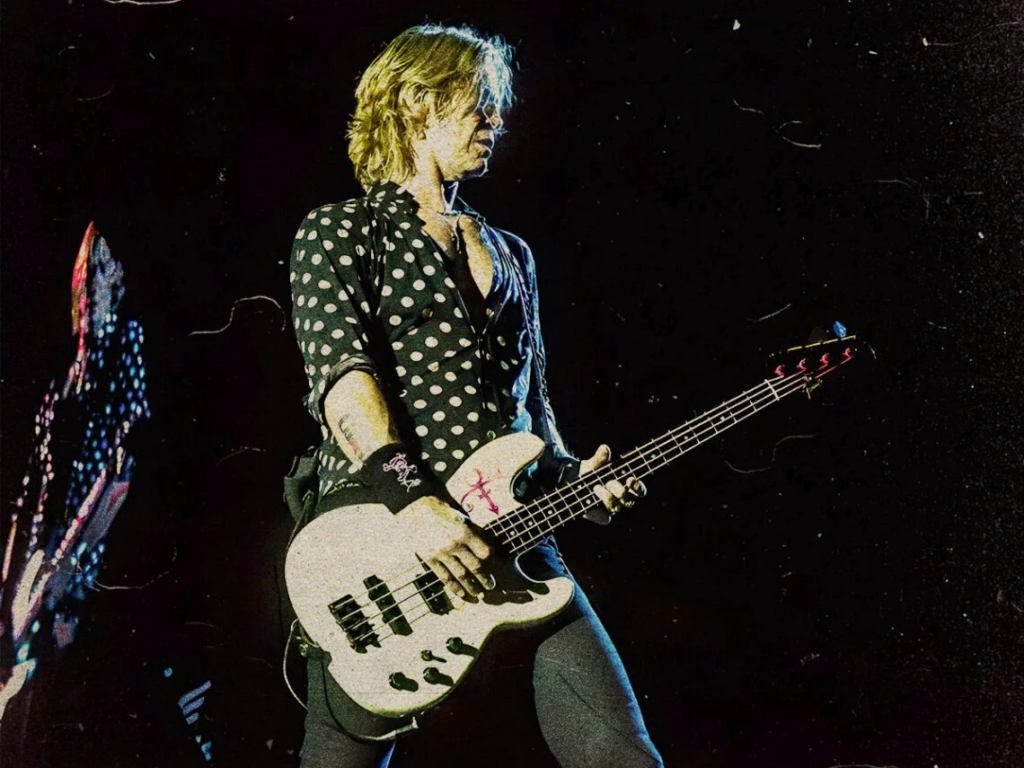
Duff McKagan is often described as “the bassist of Guns N’ Roses.”
That description is technically correct — and completely insufficient.
Duff McKagan was never just the bass player.
He was the bridge between punk and hard rock, between chaos and structure, between collapse and survival.
If Axl was volatility and Slash was melody, Duff was spine.
Early Life: Punk Before Hollywood
Duff McKagan grew up in Seattle, long before the city became synonymous with grunge.
His musical roots were not in glam rock or classic rock mythology — they were in punk. He played in multiple local punk bands and absorbed a completely different philosophy of music:
- speed over polish
- urgency over perfection
- authenticity over spectacle
This background shaped everything he later brought into Guns N’ Roses. Duff didn’t approach rock as theater. He approached it as confrontation.
When he moved to Los Angeles, he wasn’t chasing fame — he was chasing survival through music.
Joining Guns N’ Roses: The Missing Element
When Duff joined Guns N’ Roses, the band already had ambition and volatility. What it lacked was balance.
Duff’s bass playing did something subtle but critical:
- It locked into Steven Adler’s swing.
- It reinforced Izzy Stradlin’s rhythm work.
- It supported Slash’s melodic phrasing without crowding it.
He wasn’t flashy. He wasn’t decorative.
He made the chaos coherent.
Without Duff, Appetite for Destruction would have sounded looser and more unstable. With him, it sounded dangerous but controlled.
Appetite for Destruction: Bass as Weapon
On Appetite for Destruction, Duff’s bass tone cut through the mix with clarity and aggression.
Unlike many hard rock bassists of the era, he didn’t bury himself under distortion or low-end mud. His tone was:
- punchy
- defined
- rhythmically precise
You can hear it immediately in tracks like “It’s So Easy” and “Welcome to the Jungle.” The bass doesn’t just follow the guitar — it pushes it.
Duff’s punk background gave Guns N’ Roses an edge that separated them from the glam metal scene. It made the band sound leaner, faster, more direct.
The Illusion Era: Expanding Role
By the time Use Your Illusion I & II were released, Duff had grown far beyond the role of bassist.
He contributed songwriting, backing vocals, and a stabilizing presence within a band that was beginning to fracture.
As the production grew larger — orchestration, piano ballads, political themes — Duff’s bass lines kept the songs grounded.
In an era when egos expanded, Duff became more internally disciplined.
The Collapse Years: Surviving the Implosion
The 1990s were brutal.
Fame, addiction, exhaustion, and internal conflict tore Guns N’ Roses apart. Duff’s struggles with alcohol nearly cost him his life — a turning point that changed his trajectory permanently.
Unlike many rock figures who burned out, Duff recalibrated.
He:
- got sober
- returned to education
- studied finance
- built business discipline
This evolution is one of the most underrated aspects of his story. Duff McKagan did something rare in rock history:
He survived.
Beyond Guns N’ Roses
After the original lineup fractured, Duff didn’t disappear.
He formed new bands, collaborated across genres, and remained active in the music industry. His solo work revealed a more introspective, controlled artistic side.
But no matter the project, his identity remained consistent:
- direct
- rhythm-focused
- emotionally grounded
He never tried to reinvent himself as something he wasn’t.
Duff’s Bass Philosophy
Duff McKagan’s playing is often described as simple — but simplicity is misleading.
His bass work prioritizes:
- groove
- timing
- structural reinforcement
He rarely overplays. He understands space. He understands momentum.
In Guns N’ Roses, that restraint was essential. Without it, the band would have imploded musically long before it imploded personally.
The Reunion Era: Stability in a Legacy Act
When Guns N’ Roses reunited, something was immediately clear:
Duff’s presence changed the atmosphere.
The chaos was still there. The scale was massive. But the internal tension felt anchored.
Duff brought:
- maturity
- experience
- long-term perspective
He became not just a musician, but a stabilizer in a band historically defined by volatility.
Why Duff McKagan Matters in Rock History
Duff represents something rare:
A rock musician who:
- embraced chaos
- survived excess
- rebuilt himself
- and returned stronger
He bridges generations — from punk basements to stadium tours.
Without Duff McKagan, Guns N’ Roses would have sounded louder — but not deeper.