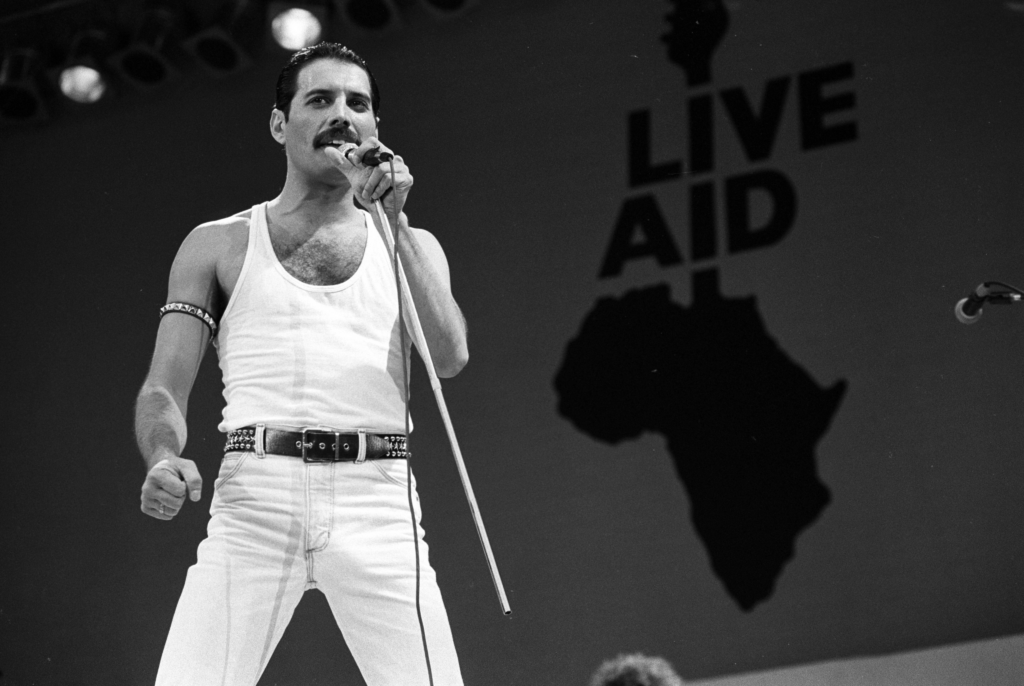
Freddie Mercury is often described with superlatives: one of the greatest singers, one of the best frontmen, one of the most iconic performers.
But those descriptions miss the core truth.
Freddie Mercury was not “one of”.
He was a category that appeared once and then disappeared.
This is the full story of how a shy art student became the most commanding presence rock music has ever seen.
Early Life: Farrokh Bulsara Before Freddie Mercury
Freddie Mercury was born Farrokh Bulsara in 1946 in Stone Town, Zanzibar. His family background was Parsi, and his upbringing combined strict tradition with cultural displacement.
From early childhood, Farrokh showed a sensitivity to music and art rather than to physical dominance or rebellion. He learned piano at a young age and was drawn to melody and harmony long before he was drawn to rock.
At boarding school in India, classmates already noticed two things:
- his musical ability
- his difference
He was not loud. He was not aggressive.
He was observant — and deeply internal.
That internal world would later explode on stage.
Moving to England: Outsider by Default
When Freddie moved to England as a teenager, he entered a society where he stood out immediately — by accent, appearance, background, and temperament.
Instead of attempting to blend in, he did something far more dangerous:
He reinvented himself.
Freddie studied art and graphic design, developing an acute understanding of:
- visual balance
- symbolism
- presentation
This education would later shape not only Queen’s imagery, but Freddie’s understanding of performance as a complete visual language, not just sound.
The Birth of Queen and the Freddie Persona
Before Queen, Freddie sang in small bands, experimenting with styles and personas. He was not immediately accepted as a frontman. His confidence on stage was learned — not inherited.
When Queen formed, Freddie made a decisive move:
he abandoned Farrokh Bulsara and became Freddie Mercury.
This was not a nickname.
It was a constructed identity.
The name “Mercury” evoked speed, communication, and mythology. Freddie understood that rock music was not just about authenticity — it was about myth-making.
Voice: Power Without Rasp
Freddie Mercury’s voice defies simple classification.
Unlike many rock singers, he did not rely on constant distortion or grit. His power came from:
- projection
- phrasing
- breath control
- emotional timing
He could sing with operatic clarity and still dominate loud guitars and drums. More importantly, he could command attention without shouting.
His vocal confidence allowed Queen to experiment musically in ways few rock bands dared.
Songwriting: No Respect for Boundaries
Freddie Mercury treated rock music as a playground, not a rulebook.
He wrote songs that:
- ignored genre expectations
- embraced theatricality
- shifted mood within minutes
Bohemian Rhapsody was not written to impress. It was written because Freddie believed the audience could handle complexity.
That belief changed rock music’s relationship with ambition.
Stage Presence: Control Over Chaos
Freddie Mercury’s stage presence was not based on aggression.
It was based on authority.
He understood timing better than almost any performer:
- When to move
- When to stop
- When to let silence speak
His famous half-microphone stand was not a gimmick. It became an extension of his body — a visual anchor for movement, posture, and gesture.
Freddie did not chase the audience.
He led them.
Live Aid 1985: The Moment Everything Stopped
Freddie Mercury’s performance with Queen at Live Aid is often described as the greatest live performance in rock history — and not without reason.
In under 25 minutes, Freddie demonstrated:
- total vocal control
- absolute audience command
- confidence without excess
He turned a global crowd into a single instrument.
This performance did not depend on production or volume.
It depended on presence.
From that moment on, Freddie Mercury was no longer just a singer — he was the standard.
Image, Sexuality, and Defiance
Freddie Mercury refused to explain himself.
He did not offer clear labels, public confessions, or comfortable narratives. Instead, he embraced contradiction:
- masculinity and flamboyance
- humor and seriousness
- confidence and vulnerability
In an era that demanded definitions, Freddie chose ambiguity — and turned it into power.
This defiance expanded what rock culture allowed, even if it took decades to fully acknowledge it.
Later Years: Silence, Strength, and Legacy
As Freddie’s health declined, his public presence became more controlled, but his artistic drive did not weaken.
He continued to record, perform, and create with urgency. Those close to him later described a man who was acutely aware of time — and determined not to waste it.
Freddie Mercury passed away in 1991, but his presence did not fade.
If anything, it became clearer.
Why Freddie Mercury Still Stands Alone
Freddie Mercury matters not because of nostalgia, but because his fundamentals do not age.
He understood:
- performance as communication
- scale as emotion
- confidence as structure
Many have tried to imitate him.
None has replaced him.
Concluding Thoughts
Freddie Mercury was unlike any person in rock music.
He remade rock to suit him.
That is the reason, many years later, his shows still seem* alive, not kept in the past, not far away, not to be legendary.
They feel alive.